
2015 - Mobilità sociale / Social mobility
Archivio multimedia

The shifts and the shocks: what we've learned - and have still to learn from the financial crisis
Martin Wolf will discuss his recent book, The Shifts and the Shocks: What We've Learned - and Have Still to Learn - from the Financial Crisis. He will explain why the post-2007 financial and economic crises have been hugely important events. He will consider their causes and how they were dealt with. He will conclude that the responses still need to be significantly more radical than today's conventional wisdom recognises.
Transition from school to work
In contrast to other countries, youth unemployment did not increase during the recent recession in Germany. This success has been mainly credited to the German training system. This is however not correct. The lecture will discuss the strengths and the weaknesses of the training system in promoting young people’s social inclusion and transitions into skilled employment.

Inequality, democracy and the future of the media
With rising inequality, there is a risk that money increasingly corrupts politics-the rich using their resources to influence electoral, legislative, and regulatory process through campaign contributions, lobbying and the financing of the media. Hence preserving democracy-“one person one vote” rather “one dollar one vote”-requires to think about a new economic and legal framework for the future of the media. In this lecture and in her recent book, Julia Cagé proposes a new model at the intersection between shareholder companies and nonprofit foundations.

Polarization, AI and Polanyi's paradox
I offer a conceptual and empirical overview of the evolving relationship between computer capability and human skill demands. I begin by sketching the historical thinking about machine displacement of human labor, and then consider the contemporary incarnation of this displacement—labor market polarization, meaning the simultaneous growth of high-education, high-wage and low-education, low-wages jobs—a manifestation of "Polanyi’s Paradox." I discuss both the explanatory power of the polarization phenomenon and some key puzzles that confront it. I finally reflect on how recent advances in artificial intelligence and robotics should shape our thinking about the likely trajectory of occupational change and employment growth.

Capital in the 21st century
What are the grand dynamics that drive the accumulation and distribution of income and wealth? In Capital in the Twenty-First Century, Thomas Piketty analyzes a unique collection of data from twenty countries, ranging as far back as the eighteenth century, to uncover key economic and social patterns. In this lecture, he will return to some of debates and discussions that followed the publication of his best-selling book in Europe, Asia and America.

Housing and the secular rise in wealth inequality
The ratio of wealth over income is back to the levels at the end of the 19th century. It is however actually due to the rise in housing, itself due to better access to property after WWII and rising housing prices over the last 25 years. Worries about diverging wealth inequality have therefore been quite exaggerated.

INET Lecture - Income inequality, the great recession, and slow recovery
In 2008 and 2009, the US economy experienced its deepest recession since the 1930s and the recovery, from what is now called the “Great Recession,” has been disappointing. Growth has been slow; the employed share of the working age population remains much below its level before the recession even though interest rates have been kept unusually low in an attempt to bolster the recovery. Moreover, a central feature of the US economy in recent decades has been a historic rise of income inequality.

INET Lecture - The great divide: inequality and how to reduce it
In this talk, Professor Fazzari will link these two salient aspects of the US economy. He will summarize research that associates the large run-up of household debt prior to the Great Recession with the falling share of income earned by the bottom 95 percent of the income distribution. He will show that the end of this borrowing boom coincided with the onset of the Great Recession, and that the unusually large decline in spending was concentrated in the group of households whose income share had fallen. Finally, he will present evidence to support the view that that the decline in the share of income earned by the bottom 95 percent now constrains US household spending and therefore helps to explain the slow recovery from the Great Recession.

What's happening to social mobility, and why do we care?
There is enduring policy interest in what is happening to social mobility. I summarise recent headline findings that policy-makers have referred to regarding trends and cross-national differences. I ask how we should interpret these findings, referring to measurement "basics" (concepts and measures, and data issues), and suggest topics about which we need to know more.
The right to be mobile
Around the world, the absence of political and economic rights for the poor majority is one of the biggest barriers to their upward mobility. In the absence of such rights, the political elite and the economic elite merge into a combined elite that preserves their grip on their highly unequal incomes indefinitely. Modern foreign aid programs can unintentionally make this problem worse by supporting such elites in poor countries. The presentation will illustrate these points with examples from Ethiopia, Uganda, and Colombia, as well as historical examples from New York City and Italy, and will also discuss the application to the U.S. and Europe today.
Inequality - What can be done?
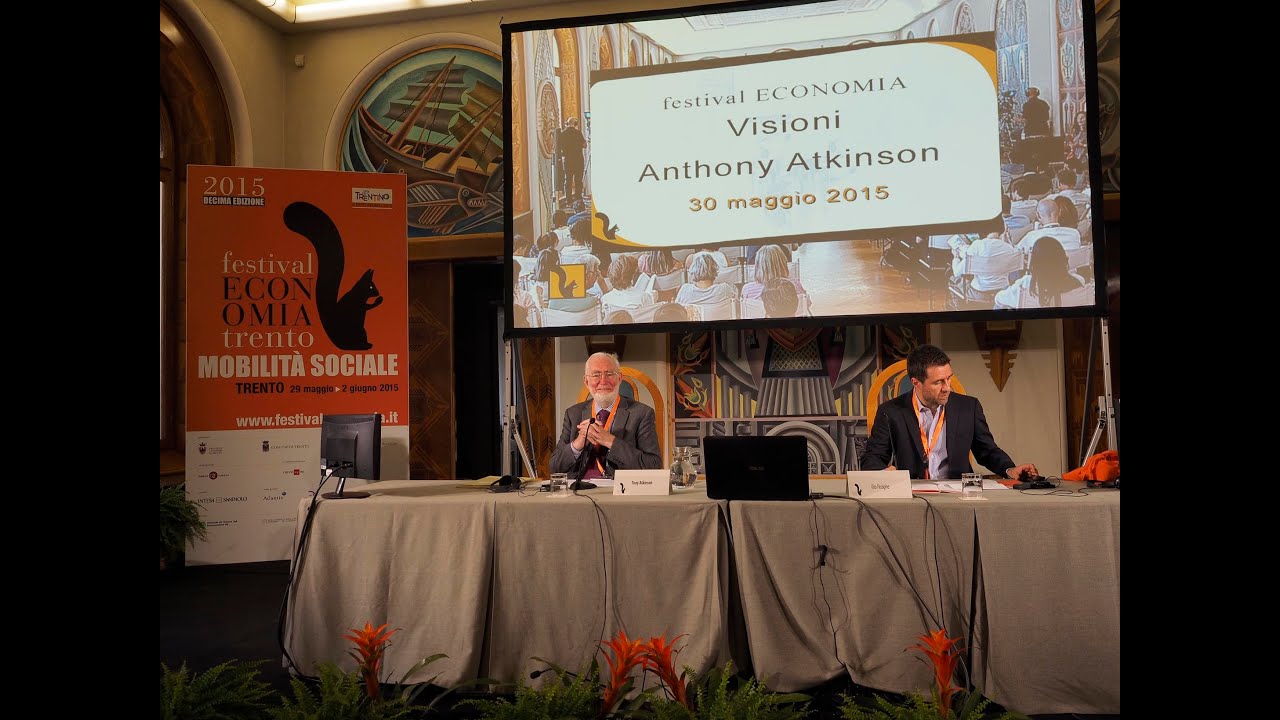
Inequality is high on the political agenda, but there have been few concrete proposals as to how it can be realistically reduced. In my talk I will outline ambitious new policies in five areas: technology, employment, the sharing of capital, taxation and social security. These provide new ideas as to how we can make serious inroads into reducing poverty and bringing about a fairer distribution of national income.

Is global equality the enemy of national equality?
The paradox of our times is that global equality seems to be in tension with domestic equality: as the distribution of income in advanced societies has become more unequal, global income equality has actually fallen, thanks to rapid growth in low-income Asian countries (China in particular). In this talk, I will examine the links between these two processes and offer some ideas on how the tension can be eased.

Agorà - film and debate with the director
Screening of the documentary film (in Greek with English subtitles) on the Greek situation, preceded by a debate on the policy followed by the EU in Greece. The director of the film will be present and available after the screening for debate with the public.

Why did women obtain rights?
Why did women obtain basic rights? Were these won or granted? I will examine a fundamental right obtained by women - the right to manage and own property once married - and argue that this right was mostly granted by men over time in response to incentives created by lower fertility. In particular, I will show that having fewer children made men care more about the rights of their daughters and less, relatively, about the privileges that they enjoyed as husbands. In other words, the cost to men as fathers became more important than the benefits to men as husbands from a patriarchal regime.

Coping with uncertainty when alla are talented
Hi-performance systems like the sciences, arts and sports rely on various forms of competition to find out who will ultimately be successful. Uncertainty pervades the system and is endemic in the career of individuals. Based on my experience with the European Research Council, ERC, and on a wide range of literature on social mobility in academic labour markets I will reflect on how scientists cope with uncertainty under conditions in which everyone is talented, but not everyone will succeed.

L'ascensore criminale
Sia la mafia, sia la camorra sia la ‘ndrangheta offrono ai giovani prospettive di rapido e “facile” guadagno. Le fortune economiche dei boss sono leggendarie e i loro stili di vita diventano modello di comportamento per la manovalanza criminale. Un magistrato e un sacerdote impegnati in prima linea nella lotta alla criminalità organizzata da Palermo a Reggio Calabria e a Roma affrontano senza reticenze un tema essenziale per la crescita sociale e civile dell’Italia.

Italia, Francia e le riforme
Italia e Francia vengono spesso messe all’indice come nazioni con forti squilibri e che hanno bisogno di profonde riforme economiche. Cosa ne pensano i primi ministri dei due Paesi di queste osservazioni mosse spesso dalle autorità sovranazionali europee? E cosa pensano loro del ruolo dell’Europa nel promuovere il ritorno alla crescita dei loro Paesi?
Europa – Italia
Lo sviluppo economico dei singoli paesi e dell'Europa nel suo insieme richiede visione di lungo periodo, leadership condivisa, fiducia reciproca. Che scarseggiano. Un confronto aperto sui vincoli e le opportunità della fase che attraversiamo.

Cosa ci insegna la crisi
L’editorialista del “Financial Times” spiegherà perché le crisi finanziarie ed economiche dopo il 2007 sono state eventi di enorme portata. Analizzerà le loro cause e il modo in cui sono state affrontate, per concludere che c’è 21 ancora bisogno di risposte molto più radicali di quello che suggerisce il senso comune prevalente oggi.
Paradossi italiani. Più meritocrazia e meno mobilità ascendente
Dagli inizi del Novecento ad oggi, il peso delle origini familiari sui destini lavorativi e sociali delle persone si è progressivamente ridotto. Ma tra i quarantenni e i trentenni di oggi i flussi di mobilità sociale ascendente si sono contratti riportandosi ai livelli che facevano registrare quarant’anni or sono. Perché?

Dalla scuola al lavoro: cosa non funziona nel modello tedesco
In Germania, al contrario di altri paesi, la disoccupazione giovanile non è aumentata durante la recente recessione. Questo successo è stato attribuito soprattutto al sistema formativo tedesco, ma in realtà non è così. La presentazione esaminerà i suoi punti di forza e di debolezza nella promozione dell’inclusione sociale dei giovani e della transizione a impieghi qualificati.
Genitori alla prova. Stili educativi e conseguenze sociali
Negli anni recenti, soprattutto tra le classi medio-alte, si è diffuso uno stile di
genitorialità attivo e intrusivo mirato a fomentare l’ambizione scolare e
professionale dei figli. In realtà l’aumento della disuguaglianza di reddito è
tra le cause di tale stile di genitorialità e il ruolo crescente dei genitori
nell’educazione dei figli rischia di frenare la mobilità sociale, penalizzando le
famiglie meno abbienti e meno scolarizzate.

Disuguaglianza, democrazia e futuro dei media
Insieme alla disuguaglianza cresce il rischio che il denaro corrompa la politica, che i ricchi influenzino il processo elettorale, legislativo e normativo con contributi elettorali, lobby e finanziamento dei media. Per garantire la democrazia (“una testa un voto”, non “un dollaro un voto”) serve un nuovo quadro economico-giuridico per i media. Un modello a metà tra società per azioni e fondazioni non-profit.

Computer o persone? Il paradossi di Polanyi
Una panoramica sul rapporto fra capacità dei computer e richiesta di competenze umane. Dopo una breve storia dell’idea della sostituzione del lavoro umano con le macchine, si analizzerà la sua incarnazione contemporanea come espressione del paradosso di Polanyi sulla conoscenza tacita. I progressi dell’intelligenza artificiale e della robotica e i loro effetti sul futuro del lavoro e la crescita dell’occupazione.